Dan Selz and Matt Abrams, co-founders of the nonprofit 1 Billion for Trust, have spent their careers trying to solve the world’s biggest challenges – climate change, COVID, the use of AI and tech in our systems and lives – through bold, ambitious out-of-the-box approaches, led by curiosity and collaboration.
After spending years as a screenwriter in LA, Dan Selz found himself wanting to do good in the world and make a real impact. So he went an untraditional route – he went to business school.
“I'd seen my friend group divided into the capitalists who were like, ‘I want money and nice stuff’ …and then I had my do-gooders who were like, ‘I want to save trees,’ who saw money as the root of all evil,” explains Selz. “And neither of these narratives felt true to me. Capitalism could scale bad stuff, certainly, but couldn't it also scale good stuff?”
Building trust in the U.S. through innovation and impact
With an MBA in hand, Selz began to see his purpose as one that uses money as a force for social good, first as a Senior Director of the XPRIZE Foundation – a non-profit that awards significant funding to companies that develop breakthroughs for addressing some of the biggest global issues. Over the seven years with XPRIZE, Selz worked on a rainforest prize, a COVID testing prize, and he led the design of a $100 million carbon removal prize that Elon Musk sponsored.
And then, in 2016, he started volunteering for Braver Angels, a nonprofit that's dedicated to bridging the political divides between Blue America and Red America. Selz was inspired to start working with Braver Angels largely because of the transformative experiences he had as a senior in high school during 9/11 in his hometown of New York City.
“The immediate aftermath of 9/11 was our whole country coming together and, you know, interviews with guys who got in their pickup in Mississippi and drove 20 hours straight, just to come help dig out the rubble,” Selz says. “And all that really cemented a deep love of my country and our nation…and my identity as an American that wants to be part of the United States. Being American supersedes whatever I think about this candidate or that party, so I was just really drawn to this mission of, can we bring our country back together?”
Why restoring public confidence in institutions matters
Technologist Matt Abrams was driven by the same mission. Abrams grew up in a rural lumber town in southern Oregon (“think West Virginia coal mining town, but with lumber”), living across a spectrum of identities and experiences. He’s the son of a doctor who was also an Orthodox Jew and a Korean War veteran, and a Methodist mother who worked as a nurse. “I grew up going to church and going to temple, [and because my dad was a doctor in a small community] I saw the mill owner’s side, I saw the logger’s side,” Abrams explains. “It was a formative period for me in terms of seeing and understanding divisiveness.”
Abrams went to Chicago for college to study Computer Engineering in the early years of the internet. He then spent over twenty-five years in the software and tech industry, including serving as a General Partner and Venture Partner at Venture Capital Funds, before co-founding the Decency Project and Leadership Now (a membership organization of business leaders who care about creating a better democracy systemically). Leadership Now is where Abrams met Selz, and 1 Billion for Trust’s other co-founder, Peter Brack.
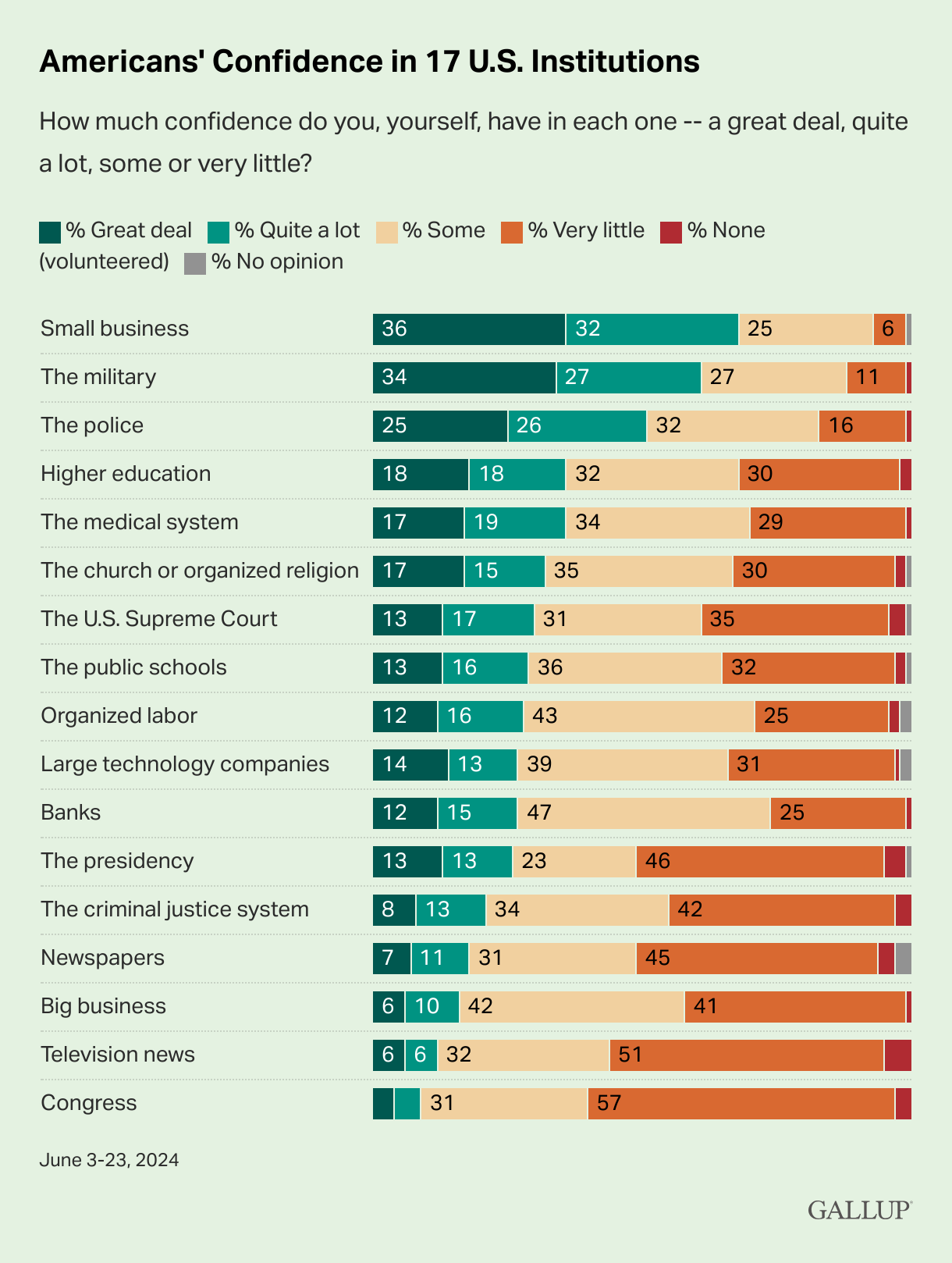
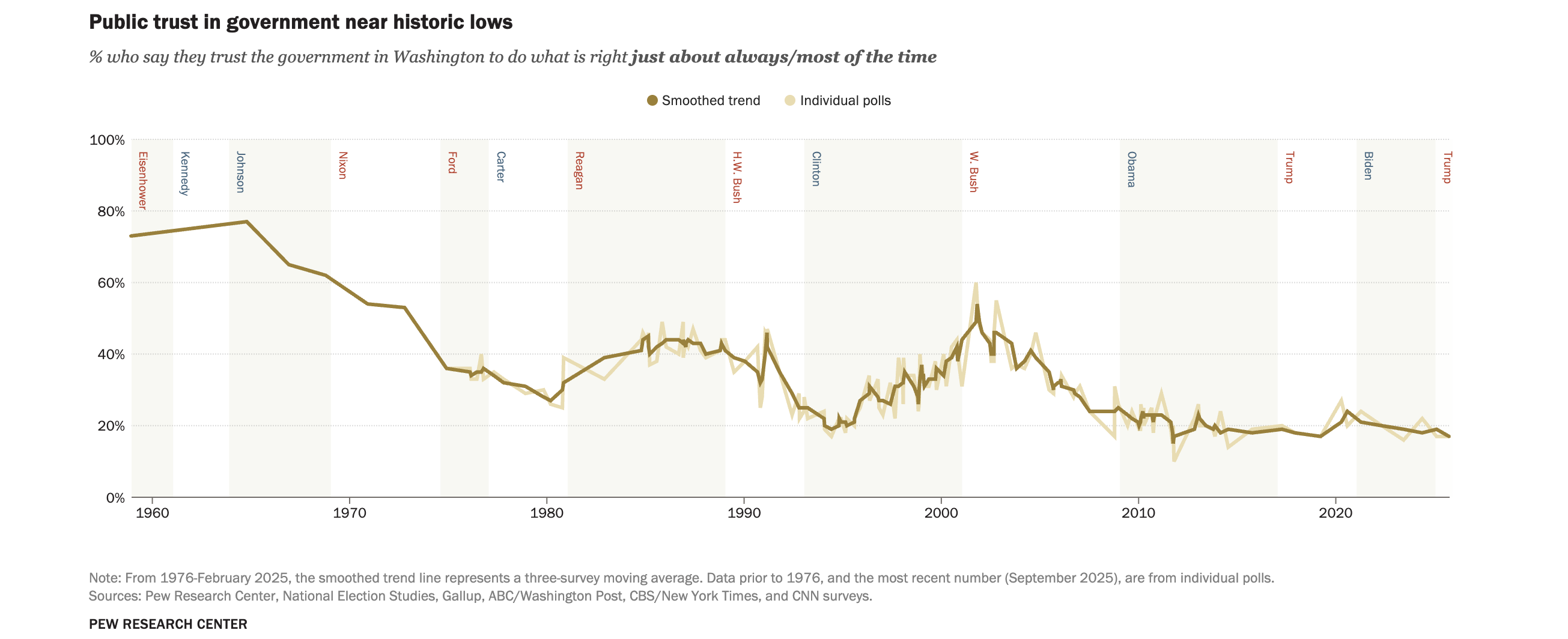
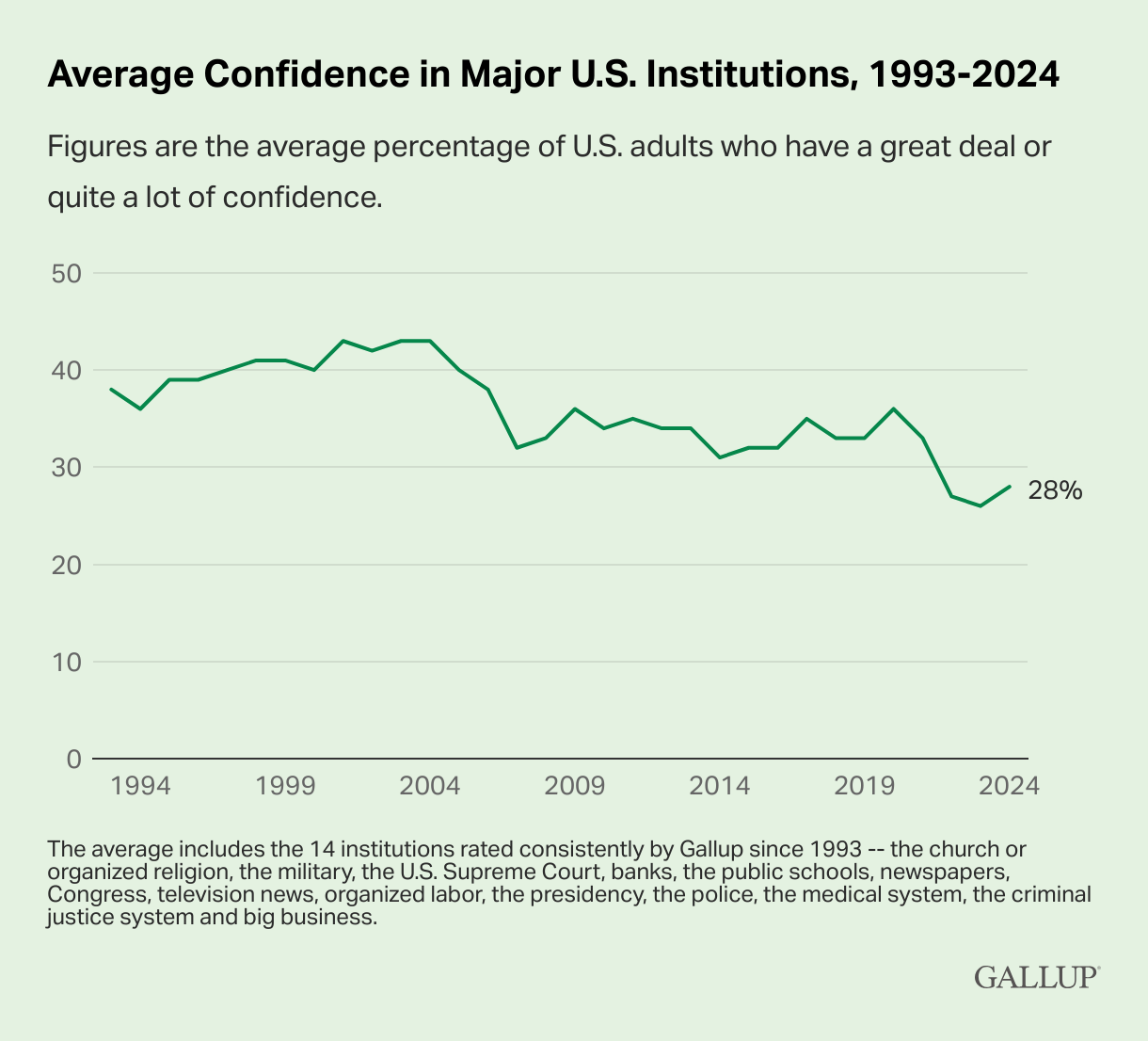
As Abrams, Selz, and Brack began working together on innovating democracy through a business lens, they quickly realized that they weren’t actually tackling the right problem. As polls conducted in 2025 by Pew and Gallup show, Americans' trust in systems and institutions is very low. Selz believes that this proves that Americans don’t have an issue with democracy; rather, “Americans are in a crisis of trust.”
“We really struggle to make sense of this increasingly complicated, messy world,” Selz says. “We don't trust our information. We don't trust our neighbors. We don't trust our institutions. So it's really hard to have a democracy built on that kind of a foundation.”
Abrams agrees. “I think that people, particularly in an uncertain world, are looking for simple answers to incredibly complex issues and problems, and trust and trustworthiness is that framework that allows us to navigate through incredibly volatile, complex, and uncertain environments.”
Why democracy and trust in government are inseparable
Another reason for turning to work on the problem of trust in America instead of democracy is that Selz and Abrams believe that the word democracy has become politicized, that it’s loaded with divisiveness.
“The reality is, if you see somebody out there talking about their concerns with democracy, there's a 99% chance that person voted for Harris in the last election,” says Selz. “If you hear somebody talking about election integrity, they're probably voting for Trump, right? And so when we started off this journey, we talked a lot about being nonpartisan. That was what we wanted to do. And we eventually came to the belief that that's bullshit, because nobody's nonpartisan.”
Selz and Abrams both acknowledge that they come to this work with their own political beliefs, and expect nothing less from anyone that they work with. So what they’re focused on targeting, as they build the 1 Billion for Trust community, is authenticity and balance across the political spectrum.
“So progressive left, centrist left, centrist right, MAGA right, libertarians, greens, like everybody needs to be part of that,” Selz says. “We're not going to save our country with 50.1% of the population, right? We've engineered this from the ground up to be a place where maybe 85% of Americans can find a home. And the only way we can do that is by building that balance to everything that we're trying to do.”
Building community to fuel the trust renaissance
1 Billion for Trust is deeply rooted, Selz says, in political scientist Robert Putnam’s belief that community is one of the key drivers of trust, which he wrote about in his famous book, Bowling Alone: The Collapse and Revival of American Community. This is why the first stage of their work will focus on building a nine million-person community to “drive the trust renaissance in the U.S.”
“We really believe if we can get 9.17 million people (3.5% of the American population) to become part of this movement, to be thinking in terms of trust and caring about trust and talking about trust in their PTA meetings and knitting circles and soccer teams, this country's going to feel a lot different, “ Selz believes.
1 Billion for Trust is focused on creating a capital ecosystem to create “trust-based solutions” in America – which is why they put the 1 Billion in their name. The goal is to mobilize their community to contribute up to one billion dollars per year toward projects and organizations that strengthen the foundations of a trustworthy and trusting society.
“If you were to ask me, ‘What is success? What do we want to see 10 years from now?” Abrams says, “It’s that we have a rich and diverse capital ecosystem, where there's the dollars, the people, the talent, building and creating solutions to solve for the trust in information, the trust in each other, the trust in our institutions.”
Community as the foundation of public trust at scale
1 Billion for Trust recently launched the first step of their community-building efforts – facilitating small group convenings across the country (25 or 50 people per group, in-person and online). Their goal is to have 10,000 people signed up by the end of January 2026 to begin gathering real-time, people-driven data on how to “move the needle on trust,” Selz says.
Using NationBuilder as the hub for all actions taken by a community member (including donations, survey questions, petition signatures, and events) is a key part of the organization's strategy. With signup pages capturing a wide variety of different self-reported info from community members via tags and custom fields – and taking advantage of NationBuilder’s open API to bring in data from partner organizations – 1 Billion for Trust is creating an exciting new metric.
“Using NationBuilder, we've been building out what we think of as the first ‘trust score’ that is going to be embedded across the nonprofit. [Because of the integrated system] we will be able to see the most successful drivers of trust for a person, what's working, what's not, and also come to understand key segments or personas within our community.”
A future built on mutual trust
Abrams and Selz, and everyone at 1 Billion for Trust, are committed to working together for the long haul in order to achieve their dreams for American society.
“Imagine a blank slate, a blank America, wipe away every current politician and political party and outlandish media personality… forget everything you know about this moment. What would it feel like to go to an election?” Selz says. “Sure, you're going to care who wins or loses, but no matter what happens, you trust the outcome, you trust the people, you trust the offices, you trust the institutions… that's the world we need to get to.”
The 1 Billion for Trust team is already inspired by the momentum and energy they’re getting from people all across the country. “Most people want to trust. Most people want to be trustworthy. And they want to see that type of world 10 years from now,” Abrams says.
Learn more about 1 Billion for Trust at www.1billionfortrust.org and be a part of their work by taking this short survey about trust.