
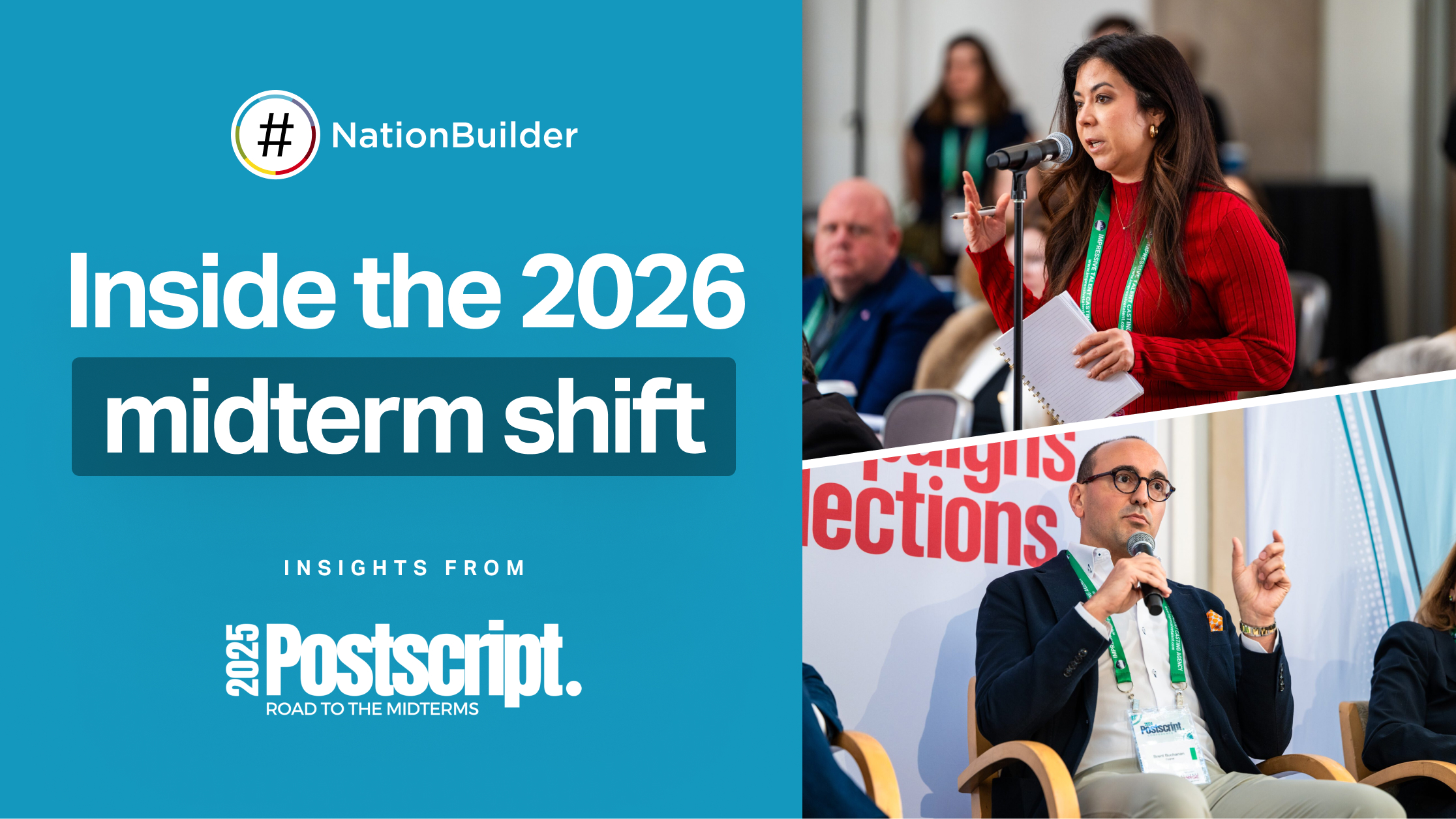
The 2025 election cycle delivered a wake-up call for political professionals on both sides of the aisle. This was at the center of the Election Postscript Conference in Washington, DC, held on December 9th, and hosted by Campaigns & Elections. Strategists, pollsters, and digital experts gathered together to break down what worked, what failed, and what changes campaigns need to make heading into the critical 2026 midterms. With political ad spending expected to exceed 10 billion dollars in 2026, the overlying message was clear: Bigger budgets will not save underprepared campaigns. Smarter, data-driven strategy will.
1. Persuadable voters are ticket splitters, not moderates
One of the most important conversations centered on the shrinking but decisive group of persuadable voters. The consensus was that these voters exist, but campaigns often misunderstand who they are.
Chris Russell of Checkmate Strategies noted that "the persuadable voter is a dwindling group," with more voters entering election cycles already committed to a party. Even so, panelists observed that roughly 6 to 7 percent of voters still split their tickets, and these voters determine close races.
The main insight was that persuadable voters are not consistent moderates, nor consistent across party lines. As Madeline Conway of Impact Research explained, they hold "a grab bag" of issue positions. A voter may be conservative on immigration but progressive on Social Security. Many are deeply cynical about politics and tune out most political messaging.
The 2024 election underscored this pattern. Donald Trump won North Carolina, but Democratic gubernatorial candidate Josh Stein won by double digits. Thousands of voters chose both candidates. This shows that persuasion pathways still exist, even in polarized states, but only for campaigns that understand these voters as cross-pressured decision makers rather than centrists.
Action item: Stop centering outreach on an imagined moderate voter. Use voting history and issue-based signals to identify true ticket splitters. Shape messages around specific issue positions and authentic candidate stories instead.
2. Traditional demographics are failing as predictive tools
Panelists agreed that demographics alone provide an incomplete picture of voter behavior. For example, the 2024 cycle delivered some of the most unexpected demographic shifts in recent history.
Democratic operatives registered new voters of color who later supported Trump. At the same time, Virginia and New Jersey elections in 2025 showed large swings away from Republican performance only months after the presidential race.
Key statistics reinforce the volatility. Trump gained roughly 15 points among men under 30 between 2020 and 2024. Black and Latino voters shifted rightward in many districts. Yet those same demographic groups swung sharply back toward Democrats in the 2025 special elections.
What caused these swings? Panelists stressed that many of Trump’s 2024 gains came from “low-information voters,” people who are not as informed about issues, who only vote in presidential years. This group of voters inflated Republican performance among certain demographic groups but did not represent a durable coalition. And these same voters turned out in 2024 but skipped the 2022 midterms (and will likely skip them again in 2026).
To avoid misreading the data, campaigns need to understand not only who voters are, but how often they vote and which issues drive their choices. For example, white college-educated women lean Democratic overall, but they also include a meaningful segment of Republican and swing voters. Younger voters of color can no longer be treated as automatic Democratic voters. They require targeted persuasion and consistent engagement.
Action item: Pair demographic information with behavioral indicators such as voting frequency, channel engagement, and issue preference. Distinguish active voters from presidential-only voters within each demographic group.
3. AI accelerates core functions but does not replace strategy
The AI panel, featuring Eric Wilson from the Center for Campaign Innovation, Gayatri Bhalla from GMMB, and Yanik Ruiz-Ramón from Blueprint, focused on how campaigns can use AI effectively without sacrificing strategy or authenticity. Their message was clear. AI is powerful, but it cannot replace human judgment.
Eric Wilson described AI’s value across four dimensions: speed, scale, scope, and sophistication. AI accelerates high-volume or complex tasks such as generating creative variations, processing transcripts, or analyzing media performance. “Down-ballot” campaigns in particular can now produce high-quality digital content once limited to large-budget operations using AI.
High-value applications include:
- Transcription and synthesis of focus group sessions
- Rapid creative iteration for digital testing
- Pattern recognition within performance data
- Administrative automation, including petition processing and basic email drafting
But panelists were also clear about AI’s limits. Ruiz-Ramón explained that "AI does not think" and that it can create output that looks polished but lacks real strategic insight. Generic AI-generated content blends into the noise, and voters notice the difference between real and synthetic messaging.
Bhalla emphasized compelling campaigns still need people "who can structure a problem, frame an idea, and know where the puck is going to skate." Strategy, judgment, and authentic communication remain human domains.
Action item: Use AI to speed up tasks that benefit from scale or automation. Keep all strategic, persuasive, and creative decisions in human hands. Train teams on how to prompt AI tools effectively to avoid generic or off-brand output.
4. Data privacy cannot be an afterthought
Data privacy emerged as one of the most urgent themes of the conference. GMMB’s Gayatri Bhalla warned that public AI tools like ChatGPT are not private and should never be used to process sensitive campaign information.
Her agency uses private, sandboxed AI environments for analysis, modeling, and creative work. "Nothing can leave our walls, and it does not feed into the engines," Bhalla says. While this approach carries higher financial costs, the panelists agreed that protecting client data is non-negotiable.
Campaigns store and process sensitive information including voter data, internal strategy documents, and opposition research. Any leak or unauthorized data use can jeopardize trust, legal compliance, and competitive advantage.
This challenge extends beyond AI. Free digital tools often monetize by collecting and repurposing user data. For political campaigns, this trade-off is unacceptable.
Action item: Conduct a full audit of your AI and digital tools. Choose enterprise-grade or private AI systems for any task that requires sensitive data. Set team-wide rules on what can and cannot be uploaded into public tools. Learn more about cybersecurity for your campaigns.
Bonus insights: The changing campaign landscape
Streaming is the new broadcast
GMMB’s Gayatri Bhalla notes that digital is now a primary media channel. Most voters under age 65 consume television content through streaming platforms, not broadcast TV. Connected TV offers precision targeting, geographic accuracy, and quick turnaround. Campaigns must plan media buys with streaming as a core component, not an optional add-on.
Early voting extends the campaign timeline
Mail-in and early in-person voting mean that many voters cast ballots up to 45 days before Election Day. Campaigns that focus their persuasion and turnout efforts on the final two weeks risk missing a large portion of the electorate. This shift also affects fundraising timelines, since campaigns need funds earlier to stay competitive throughout the extended voting period.
Mid-cycle redistricting reshapes the map
Several states implemented new district maps after 2024. Tennessee’s December 2025 special election illustrates how even heavily gerrymandered districts can produce unpredictable results. The Republican candidate underperformed Trump’s 2024 margin by 13 points. Campaigns cannot assume that “safe districts” will remain safe.
Building your 2026 campaign playbook
The 2026 midterms will unfold in a challenging environment. Demographic coalitions are shifting. Voters are consuming media across fragmented platforms. And national sentiment continues to shift.
This uncertainty creates an opportunity for campaigns that are willing to challenge assumptions, invest in integrated data, and build authentic relationships with voters. Speakers at the Postscript conference all aligned on one point: success in 2026 will not come from the largest budgets or the flashiest tools. It will come from a deep understanding of voters, early and consistent communication, and an adaptive strategy grounded in real data. Campaigns willing to engage voters directly, who understand issue-level motivations, and invest in privacy-first digital systems will be positioned to lead.
NationBuilder supports campaign professionals with tools that enable authentic voter engagement and data-driven decision making. Learn more at nationbuilder.com.
