
Over the past decade, trust has steadily eroded in the channels campaigns leaned on most. Digital ads are increasingly restricted, fatigued, and distrusted. Social platforms are noisy, polarised, and rarely owned by the organisations doing the work. Over-optimised data models have often displaced real conversations, something I experienced first-hand during the UK campaign to remain in the EU, where visibility in modelled support areas was prioritised over actually talking to voters. AI has amplified all of this, for better and for worse.
The result is that transactional, shallow, broadcast-first campaigning is now more likely to trigger suspicion than engagement. Over time, this erodes trust in the relationship between organisations and their audiences.
At the same time, campaigns are under more pressure than ever. Teams are smaller. Expectations are higher. Technology still has to help.
So what is cutting through?
A shift in how technology is used
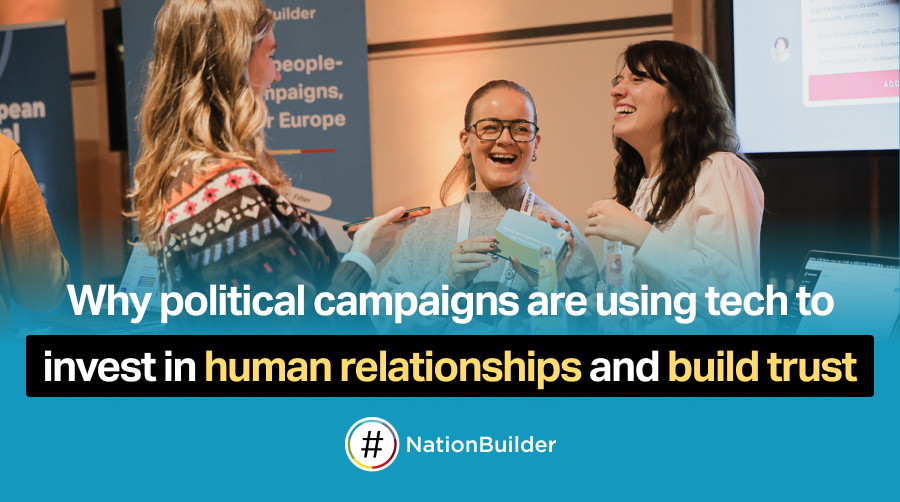
What is emerging is not a rejection of innovation, but a more deliberate deployment of it. This was a key point of discussion in a panel I took part in on the future of campaigning and political tech at the 2026 Political Tech Summit in Berlin.
Campaigns are moving away from using technology primarily to optimise reach, and toward using it to support human relationships, local credibility, and trust earned over time. This is less about new tools, and more about using existing ones with greater intent.
That shift shows up clearly across very different contexts.
The Dutch party D66 invested in infrastructure with NationBuilder that genuinely empowered local chapters. Not just access to supporter lists, but a fuller picture of volunteers as people, what they cared about, what they had already done, and how they wanted to participate next. Automation reduced administrative load, while organising remained human and local and ultimately played a part in their impressive victory in 2025.
We see similar patterns elsewhere. Unions have re-centred their strategies around relationships and trust rather than reach alone, something we explored in our Future of Membership report. Zohran Mamdani’s campaign for mayor in New York placed an almost obsessive focus on in-person organising. In the US, both Nevada Democrats and Virginia Republicans have invested in localised group engagement and supporter empowerment, rather than doubling down on hyper-digital tactics.
Outside electoral politics, local councils, advocacy organisations, and even corporate and infrastructural campaigns are rediscovering grassroots approaches as a way to rebuild trust with communities. In many cases, that trust then becomes a currency that enables progress later, whether at the ballot box, in consultations, or through fundraising.
This work can be slower. But it is the backbone of effective organising to allow mobilisation efforts to be rolled out more successfully. And it is working.
What is actually outperforming expectations
Looking across campaigns over the past year, a consistent set of tactics stand out, not because they are novel, but because they align with how people want to engage now.
First, fundraising in Europe has exceeded expectations when it is rooted in trust, local relevance, and a clear value exchange. In contexts where small-donation models are often assumed to be inappropriate (as is often the case in mainland Europe), we see the strongest results when fundraising follows relationship-building, rather than being used as the primary way to create that relationship in the first place.
Second, texting has seen a resurgence, especially in the UK, following its proven impact in the US and Canada. Used well, it feels personal and contextual rather than broadcast, allowing campaigns to engage people in a channel that still commands attention.
Third, local issue-based campaigning consistently outperforms national framing. As we highlighted in the NationBuilder 2025 Year in Review, local petitions gather more signatures, sustain engagement for longer, and are more likely to lead to follow-up action. People engage more readily when an issue is close to them, when they can see themselves in it, and when it feels actionable rather than abstract.
AI fits into this pattern too. Where we see it working best is not in replacing human judgement or voice, but in removing friction around it. Used well, it helps teams analyse data and reduce administrative load. Used badly, particularly when it automates persuasion or simulates authenticity at scale, it risks deepening scepticism rather than reducing it.
Across all of these examples, the pattern is the same. Tools work best when they support real human interaction rather than attempting to shortcut it.
Why there is hope
People are not leaving digital spaces, but they want to know who they are engaging with is real, human, and connected to the issue at hand. Humanity and locality will increasingly determine effectiveness, even at scale. The strongest campaigns use scale to open the door, then invest in peer-to-peer engagement, local issues, and user-generated activity to build trust and depth where it matters most.
Campaigns built on shared values, trust, and mutual relationships are increasingly outperforming those driven by fear, othering, and pure optimisation.
At NationBuilder, this aligns closely with how we think about infrastructure. Our role is not to replace human organising, but to make it easier. To strip out admin and repetition, to give organisations ownership of their relationships and data, and to help them see and evidence how trust and participation grow over time.
The tools that will matter most in the years ahead will not be the loudest. They will be the ones that quietly help humans show up for each other, locally, credibly, and on their own terms.
